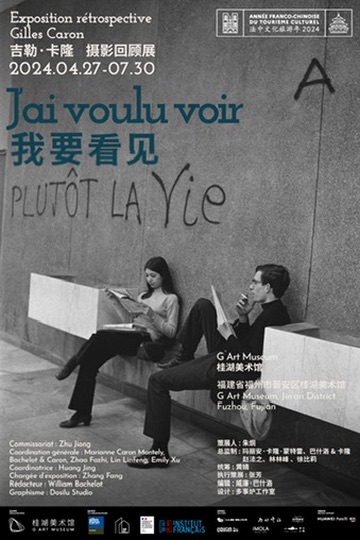
Titled “I Want to See,” an exhibition of works by French photographer Gilles Caron arrives in China in 2024. The phrase “I want to see”—taken from a letter he wrote to his mother in his youth—encapsulates the photographer’s enduring aspiration to set forth, explore, and bear witness.
It was this drive to “see” that led to the mysterious disappearance of 30-year-old Gilles Caron in 1970, while he was covering the front lines in Cambodia.
Between 1965 and 1970, Caron used his lens to document daily life, spotlight celebrities, and capture political developments. With remarkable courage, he traveled to the far corners of the globe to report on conflicts and wars—from the Six-Day War in Israel and the Vietnam War to the May 1968 protests in France, the Troubles in Northern Ireland, and the conflict in Biafra, Africa. In a career spanning just five years, Caron produced over 100,000 photographs and thousands of rolls of film, with many of his images becoming iconic visual records of major historical events.
Whether covering conflicts or artistic scenes, Caron’s focus remained consistently on “people.” During the 1960s, as the French “New Wave” cinema movement sent shockwaves through the cultural landscape, Caron—positioned on the global stage of Paris—captured portraits of prominent figures in Western arts and culture. His images often look beyond the polished facades of public figures to reveal their inner spirit. Beyond his keen observation of others, Caron also turned a critical, analytical eye toward the medium of photography itself; he frequently documented photographers at work in high-pressure or chaotic environments, prompting reflection on how “truth” is constructed.
While Gilles Caron is a household name in France, he may be less familiar to audiences in China. This exhibition features a curated selection of 60 photographs—primarily portraits—inviting viewers to see the world through Caron’s deeply empathetic gaze, to appreciate the “beauty of humanity,” and to connect with the world through his evocative imagery. On another level, the exhibition seeks to share the story of a young photographer whose brief yet brilliant life was defined by an intense desire to “look” at the world—a desire he pursued through the act of photography, striving to “see” it firsthand. Whether capturing the cherished moments of family and children or the harsh, grueling realities of life, he sought to uncover the value and strength of existence from a multitude of perspectives. Furthermore, re-examining Gilles Caron’s photographs within an art space today signifies a shift: the history of photojournalism has evolved into a history of visual art within the museum. In this digital age, our tribute to Caron also serves as a poignant reflection on the origins and evolution of photography.
We look at what Gilles Caron saw, because we, too, wish to see.